
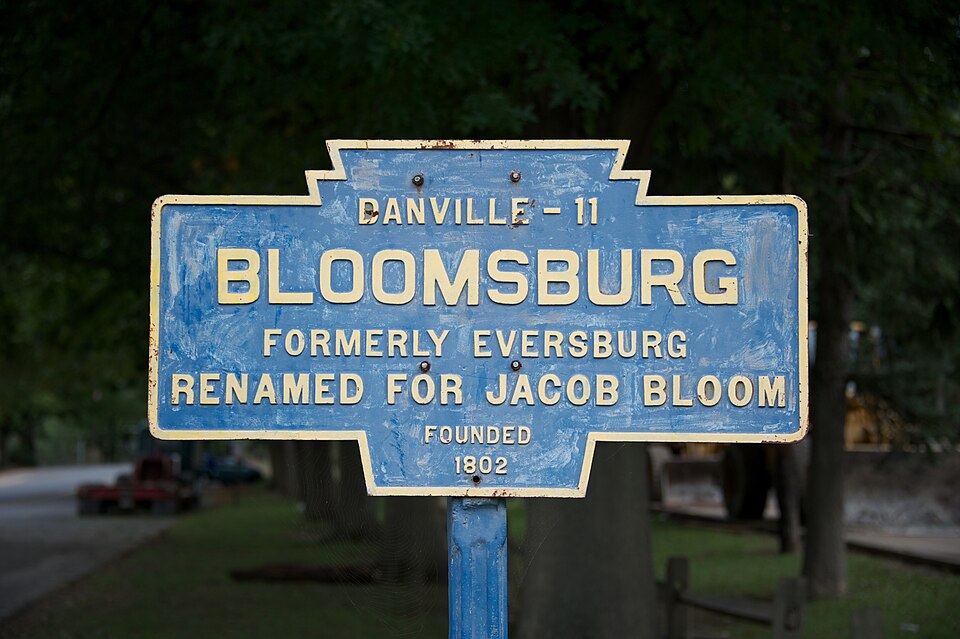
Featured photograph: Bloomsburg Keystone Marker by Cole Camplese, via Wikimedia Commons. Licensed under CC BY 2.0.

Of late, my business did summon me unto Bloomsburg, Pennsylvania, where I abode for several weeks. What began as an ordinary journey on matters of trade became a most pleasant and memorable adventure. And what a splendid season in which to travel through the Northeast! By late September, the days were mild and fair, whilst the nights had begun to bear autumn’s crisp chill. The leaves had not yet donned their brilliant raiment, save for here and there a tree offering a glimpse of the colors soon to come.
Bloomsburg, set in northeastern Pennsylvania, traces its beginnings unto the year 1802, when it was known as “Eyersburg,” or “Eyerstown,” in honor of its founders, the brothers Ludwig and John Adam Eyer. (The keystone marker states "Eversburg", which is a historical error from the 1920s). Nevertheless, in time, the settlement took the name Bloomsburg, after the surrounding Bloom Township, itself named for another early settler. In 1870, Bloomsburg was incorporated as Pennsylvania’s sole officially designated “town,” a distinction it keeps unto this day.
By the commonwealth’s reckoning, other communities are named cities, boroughs, or townships. Yet Bloomsburg’s singularity reaches far beyond this curious title. It offers much to the traveler and possesses a character and charm as distinctive as its place in Pennsylvania’s history.
Within the town proper stand many fair and ancient houses and buildings, and among them can be found the noble Victorian fountain that graces Market Square. Its enduring beauty and faithful service are a credit to all who have tended it through the years. No less remarkable is the tale of its making, which speaks to the generosity and civic spirit of Bloomsburg’s folk.
In 1884, a merchant of the town bequeathed $2,000 unto the water company, that the people might receive water freely. Rather than spend the gift for that purpose, the company offered to furnish the water without charge, provided the town council use the merchant’s bequest to purchase a public fountain. Thus was the fountain raised in Market Square in 1892. It was taken away in the 1960s, having fallen into disrepair, but the townsfolk restored it in the 1980s, and have since kept it in good order through continual care.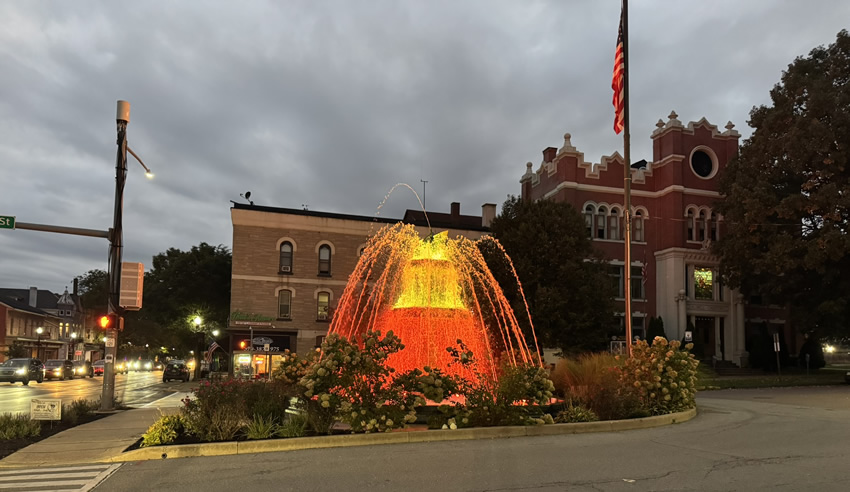
And so, through the merchant, the water company, and the good people of Bloomsburg, the town gained a landmark that yet adorns its square more than a century hence. For all its grandeur, the fountain stands as a testament to the generosity and civic pride of those who have cared for it across the generations, and as a place of tranquility for townsfolk and travelers alike.
Opposite the fountain lies the grand sight of the granite Soldiers and Sailors Monument, sixty feet in height, raised in remembrance of the Civil War.
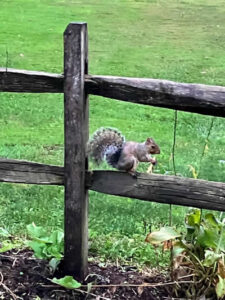 At the far end of Market Street sits Bloomsburg Town Park, a wonder in its own right, with a swimming pool, many fields for sport, picnic tables, and great pavilions fit to host gatherings of many folk. It is a peaceful retreat, where plump grey squirrels seem to regard each passerby as a likely source of morsels. Lo, before mine very eyes did a squirrel feast upon a golden french fry! Many trails invite a brisk jog or a leisurely stroll; and just across Fort McClure Boulevard, the Susquehanna River flows beside the park, adding yet more beauty to the scene. The park is yet another jewel among Bloomsburg’s many treasures.
As fortune would have it, the Bloomsburg Fair was in full revel during my visit. I spent both a day and an evening wandering its grounds, taking in the sights, sounds, and merriment. By day, a gentle mood prevailed, as families strolled at their ease among the attractions. But as dusk yielded unto darkness, the fairgrounds sprang to life beneath the glow of a million lights, and the mild daytime crowds gave way to a lively throng of evening revelers. The change was wondrous, as though I had passed through two wholly different worlds without ever leaving the fair.
The folk I met during my stay were refreshingly plainspoken and sincere, from the servers in the taverns and the attendants at Sheetz to the clerks at the inn. With a population of just over 13,000, Bloomsburg seems to keep a pleasing balance: small enough to preserve the close bonds and welcoming warmth of a little town, yet large enough to enjoy the bustle and liveliness of a small city.
Strangely, these very qualities lent Bloomsburg the curious air of a place where time had turned backward, perhaps to the 1980s. More curious still was the music. In nearly every establishment I entered, and upon some of the strongest local radio stations, the familiar tunes of the 1980s seemed to hold sway. It was almost as though the town rested beneath an unseen dome of glass, preserving the spirit of that decade whilst the rest of the world journeyed onward. The feeling was subtle, yet it lingered long enough to make me wonder what it was about this place that made the past seem so strangely near.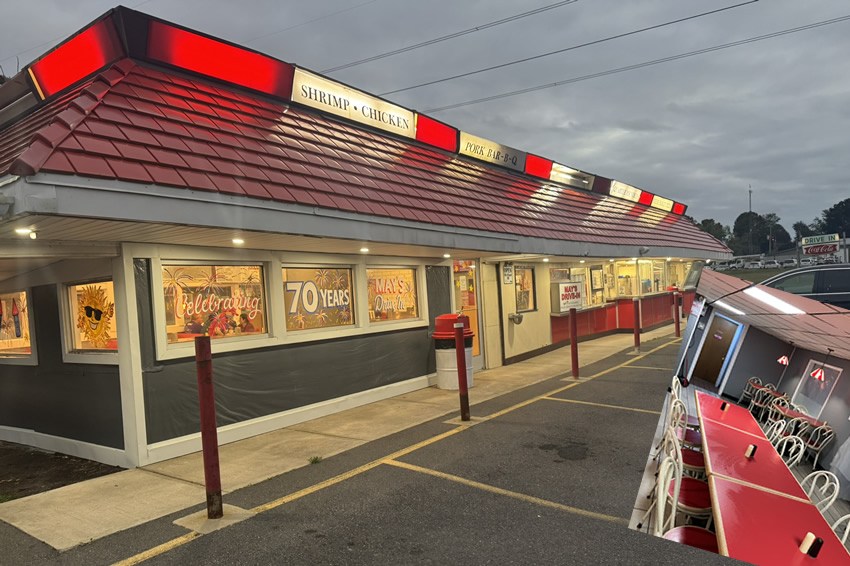
One afternoon, I stopped for my midday meal at a modest little house called May’s Drive-In, just beyond the burgh's pale. Stepping within only deepened that curious sense of days gone by. The place seemed scarcely touched by time, its red-and-white soda fountain chairs gathered around red-topped tables. All was remarkably clean and well-tended. The menu was pleasingly simple, offering familiar fare: burgers, fries, chicken fingers, root beer, and milkshakes. Nothing about the place was especially grand yet therein lay much of its charm. It felt like the sort of eating-house one might remember from decades past, where little had changed because little needed changing.
But I stray from my tale. There is much to discover beyond Bloomsburg itself, for the neighboring communities possess their own attractions and small-town charms. In Benton, travelers may visit a fish hatchery and spend a tranquil afternoon beside the nearby ponds, where ducks eagerly await a morsel from one’s hand.
Cross the bridge near Bloomsburg Town Park, and Catawissa awaits, home of Big Ben’s soda company, founded in 1926. There one may procure an assortment of old-fashioned sodas including a variety of birch beer, creams, and the fruity types, all made with pure cane sugar and bottled in glass.
A journey through the tiny village of Rupert offers a crossing over Columbia County’s oldest covered bridge, whilst Lightstreet invites the traveler to pass a pleasant afternoon browsing its antique shops. Each neighboring community has its own distinction, adding yet another measure of charm to the lands about Bloomsburg. I am told that each township doth yearly hold a great many merry revels -carnivals, harvest feasts, heritage days, and jamborees, to name but a few.
Nor would I be doing justice to this tale were I to omit Knoebel’s Groves, a little more than twenty minutes beyond Bloomsburg. This amusement park lies tucked among the woods of Elysburg and is famed for acquiring beloved rides from venues that have long since closed: the wooden Phoenix roller coaster (formerly The Rocket from San Antonio, TX) in 1985, the Grand Carousel (from Riverside Park in Piscataway, NJ) in 1941, and the Jet Star from Coney Island in the 1970s, to name but a few. It is a truly wondrous place that, once visited, shall never leave your heart. It deserves a tale of its own, which I shall save for another day.
And so, for now, I bring my reflections upon Bloomsburg to their close. Yet in truth, the tale does not quite end there. For reasons I cannot wholly explain, my thoughts return to this Pennsylvania town again and again.
Perhaps it was the few short weeks I spent there, during which I was fortunate to partake of so many delightful offerings of the season. The visit was surely pleasant and memorable, although I had scarce dipped but a toe into the water. Yet in the years since, my travels have carried me to countless other places, many no less charming or remarkable. Still, none has left quite the same mark upon me. Never before have I felt so inexplicably drawn unto a place or found its memory lingering so stubbornly in my thoughts.
What is it about Bloomsburg that yet calls to me? I cannot say. There is something almost mysterious in its hold, as though the town possessed some elusive quality I have not yet come to understand.
I wonder whether any among you who read these words have visited this place and felt the same. Or perhaps you have known another place that left you with such a curious feeling as though an unseen magnet kept drawing your thoughts back to it, long after you had departed.
I would be most glad to hear your tales.